QuickWills
Bilingual digital platform for creating legally compliant ADGM wills for non-Muslim expats in the UAE — step-by-step wizard, professional Arabic translation, and Stripe payments in AED.
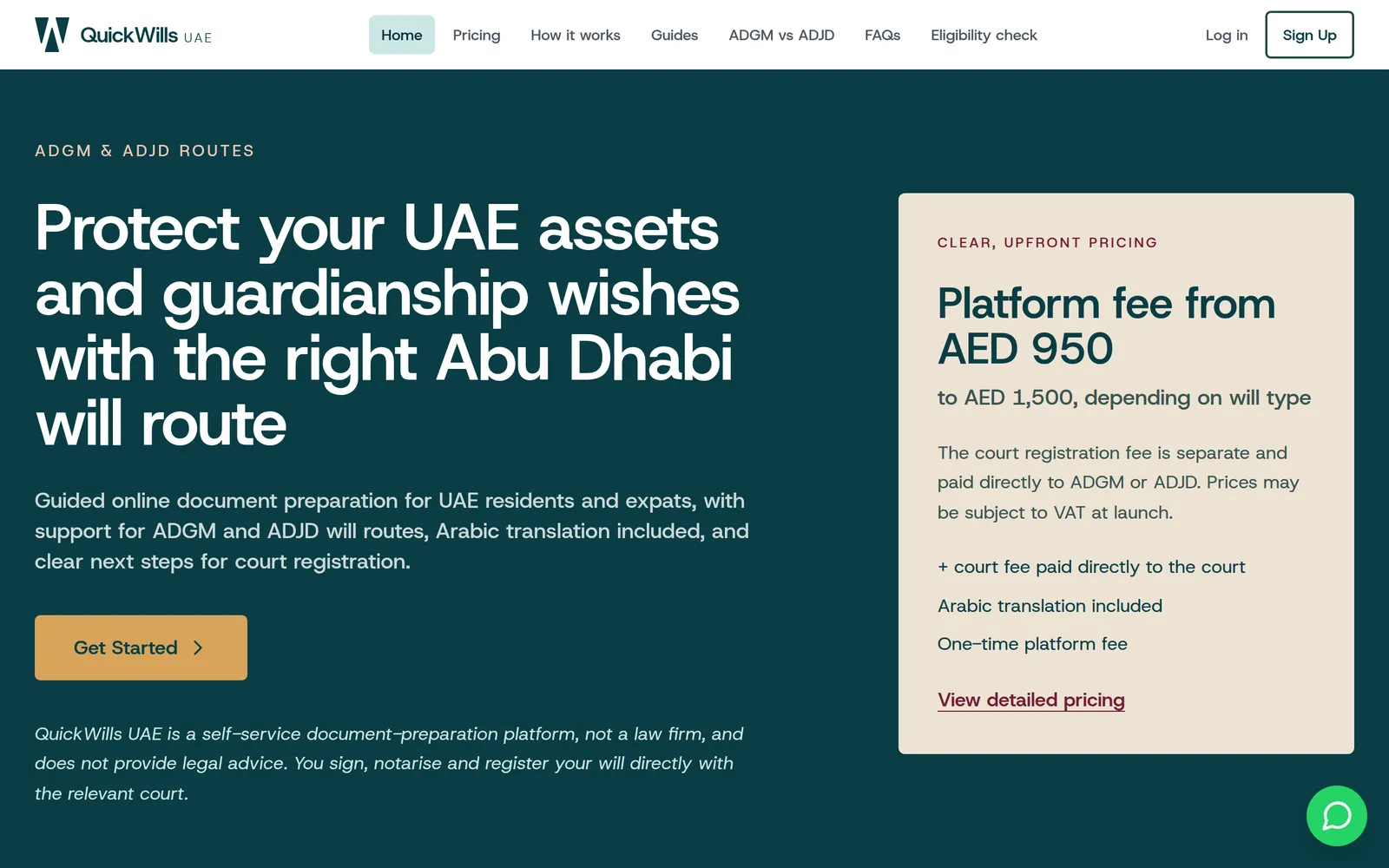
Overview
QuickWills is a digital platform that lets non-Muslim expatriates living in the UAE draft a legally compliant will registered under the Abu Dhabi Global Market (ADGM) framework — entirely online, in English or Arabic, without the cost and back-and-forth of a traditional law firm. It takes a process that is normally opaque, expensive, and intimidating and turns it into a guided experience that most people can finish in a single sitting.
For expats in the UAE, estate planning is genuinely high-stakes. In the absence of a registered non-Muslim will, local succession rules can apply by default, which may distribute assets in ways that do not reflect the person’s wishes and can leave a surviving spouse or children in a difficult position. The ADGM Wills framework exists precisely to give non-Muslims a clear, enforceable alternative — but until now, accessing it meant navigating law firms and paperwork. QuickWills makes it possible to create an ADGM will online in the UAE through a structured wizard that captures exactly the information a valid will requires.
Who it’s for
The platform is built for the large population of non-Muslim expatriates across the Emirates — professionals, families, and business owners — who need certainty about what happens to their UAE-based assets, guardianship of their children, and the appointment of executors. The bilingual English/Arabic interface means the product serves both the international expat community and Arabic-speaking users on equal footing, with content and generated documents that read naturally in either language.
What it does
- Step-by-step will wizard — a multi-stage form that walks the user through testator details, beneficiaries, asset distribution, guardianship, and executor appointments, with validation at every step so the final document is complete and internally consistent.
- Bilingual by design — the entire interface is available in English and Arabic, including right-to-left layout, and every generated will is produced with a professionally translated Arabic counterpart rather than machine output.
- Mirror wills for couples — spouses can create linked “mirror” wills that reflect each other, with conflict-safe syncing so that shared decisions stay consistent between the two documents without one partner’s edits silently clobbering the other’s.
- Instant, compliant PDF documents — completed wills are rendered server-side into polished, ADGM-formatted PDF documents ready for review and registration.
- Secure payments in AED — checkout is handled through Stripe in local currency, with webhook-driven fulfilment so the document is only released once payment is confirmed.
Architecture
QuickWills is a full-stack TypeScript product built for reliability and correctness, since the output is a legal document that people rely on.
- Frontend — Next.js 14 using the App Router, delivering a fast, server-rendered wizard with a fully bilingual, RTL-aware UI.
- Backend — a NestJS API organised into clear modules for wills, users, translation, documents, and payments, backed by PostgreSQL through Prisma for type-safe data access and migrations.
- Infrastructure — deployed on Railway with managed Postgres, environment-specific configuration, and Stripe webhooks for reliable, idempotent payment handling.
Interesting technical challenges
Arabic RTL PDF generation. Producing a legal PDF that renders Arabic correctly is deceptively hard. Arabic is right-to-left and cursive — glyphs change shape depending on their neighbours — and mixing it with Latin text, numbers, and structured legal formatting breaks most naive PDF pipelines. QuickWills uses Puppeteer to render documents through a real browser engine, which gives proper RTL text shaping, bidirectional layout, and faithful typography, so the Arabic will reads exactly as it should on the page.
Conflict-safe mirror wills. Mirror wills for couples are two documents that intentionally reflect one another, which introduces a classic concurrency problem: two people editing linked records at the same time. The syncing layer is designed to keep shared decisions aligned between partners while preventing one person’s changes from overwriting the other’s, so couples get consistent documents without data loss.
A real translation workflow. Rather than dropping raw text through machine translation, QuickWills implements a translation workflow system that manages source content and its professional Arabic equivalent as first-class, reviewable data. This keeps legal wording accurate across both languages and makes it possible to update copy in one language and track what still needs a matching translation.
Payment-gated document delivery. Because the deliverable is a paid legal document, the boundary between “will drafted” and “will paid for and released” has to be airtight. Stripe webhooks drive fulfilment with idempotent event handling, so a document is generated and delivered exactly once, only after a confirmed payment in AED.
Status
QuickWills is live in production at quickwills.ae, serving real users creating registrable ADGM wills across the UAE.